
Artwork Interpretation: Windy Avenue
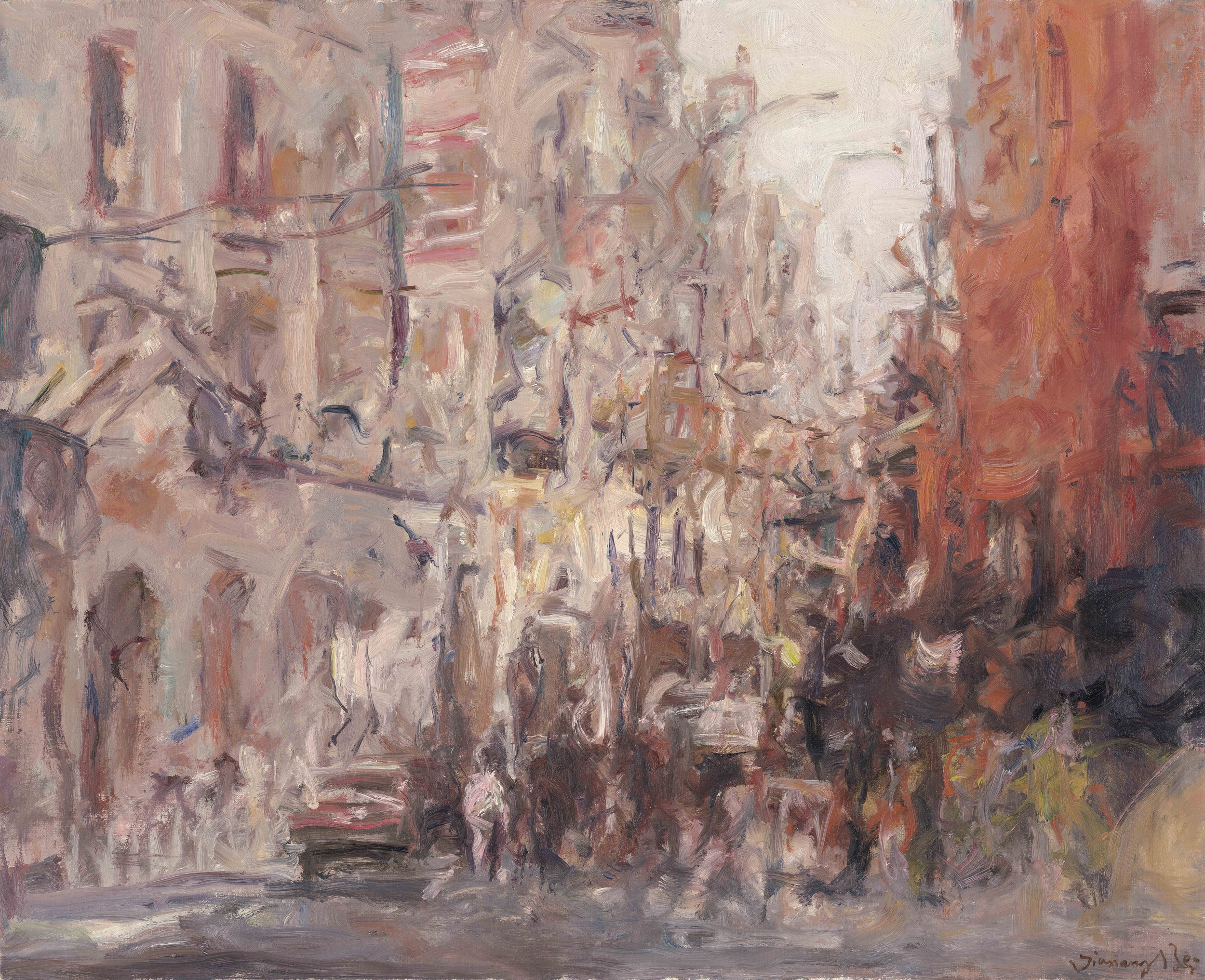
Windy Avenue
Oil On Canvas
91×73cm
Romanticism brought natural landscapes onto the canvas, and with the rise of capitalism in Europe during the 16th century, urban street scenes gradually found their way into art. These street views reflect, on one hand, the affluent life of rapid prosperity and, on the other hand, the attempts of the pseudo-intellectuals to approach art through shortcuts. Driven by the art market, street scene painting remained bound to the “commission-based” creative process of Western painting for a long time.
However, in BEI Jiaxiang’s work, this passivity has been completely transcended.
In the lower right corner, two groups of pedestrians are sketched separately in dark and light tones, effortlessly distinguishing between those approaching and those walking away in just a few strokes. Each brushstroke by the BEI is powerful yet deliberately blurs the edges, adding an indescribable dampness to the hustle and bustle of city life. In contrast, the upper left area appears much more transparent. The brushwork slows down, and the tones become purer, with the townhouses conveying a sense of detached tranquility, as if everything has turned into a state of stillness.
Yet, these seemingly disjointed parts of the painting are subtly stitched together by a beam of light created by BEI. This light not only serves to divide the composition and guide the viewer’s gaze—functions that still fall within the realm of “passive” design—but it also represents a subjective projection of the artist’s own emotions. The originally static scene begins to flow under this light, which does not fully adhere to the rules of perspective, transforming into a version from the BEI’s memory.
Compared to the third-person perspectives of street scenes by Pissarro and Sisley, BEI’s series Shanghai Impression is standing on the ground, as if he is one of the pedestrians on the street. Through this authentic viewpoint, he creates an ambiguous moment that exists between reality and memory, showcasing the invaluable “initiative” of the artist.