
Artwork Interpretation: Flicker in the Light
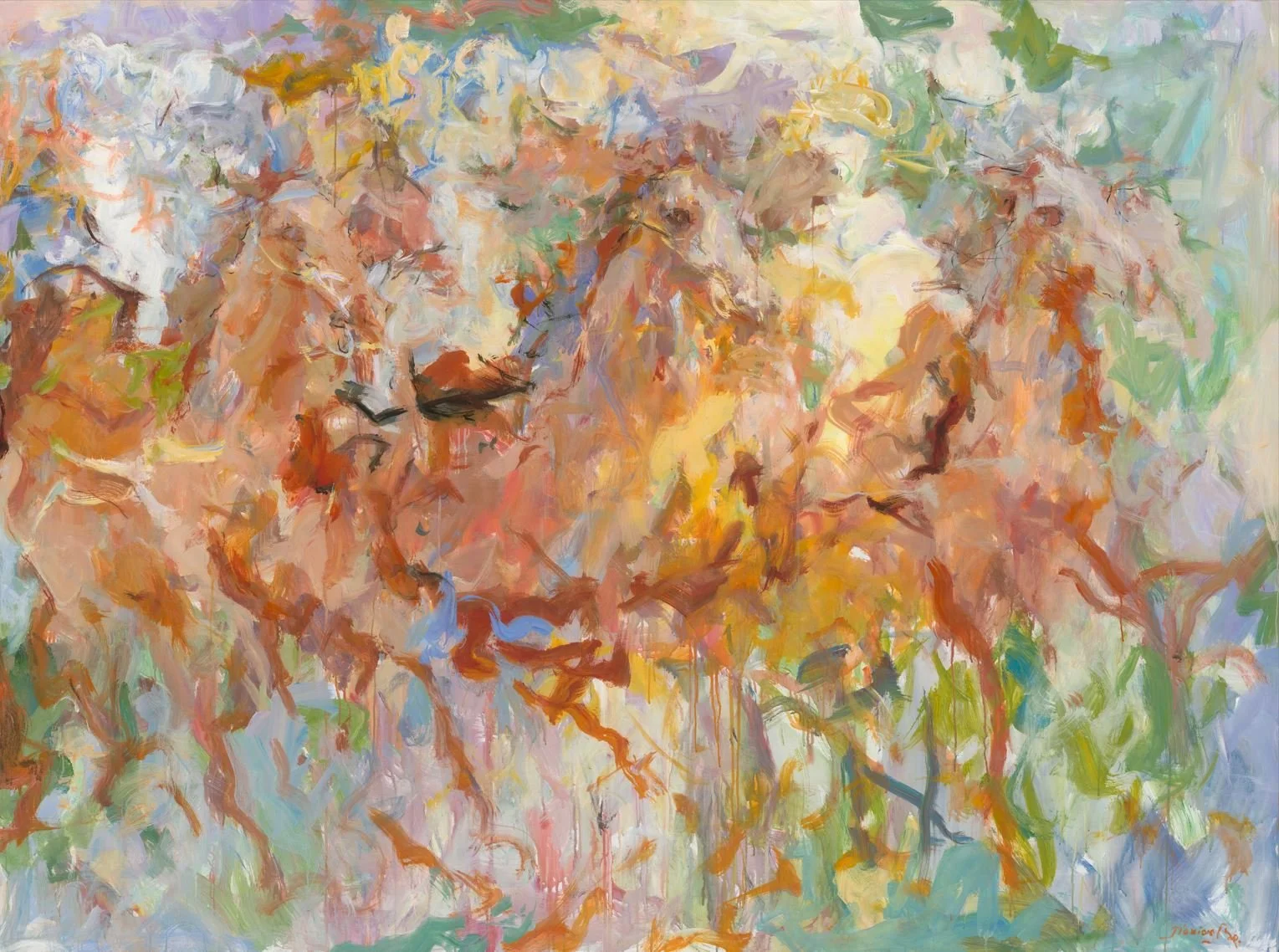
Flicker in the Light
Oil On Canvas
240×180cm
Even in the masterful application of line in the Horse series, the expression of color and light cannot be overlooked.
BEI Jiaxiang boldly employs bright hues such as grass green, egg yellow, and misty blue, capturing the impact of galloping racehorses. He even mixed substantial amounts of white into already light pigments, creating a sense of weightlessness. Coupled with the horses’ upwardly lifted hooves, it feels as if, amidst a whirlwind of dust, these steeds have crossed the boundary between reality and dreams. Not only are the horses in motion; the entire background teeters on the edge of dynamic tension.
On the traditionally brown-red depicted bodies of the horses, BEI initiates his experimental approach to color. Unmixed ochre defines the muscular legs, while the addition of carbon black transforms them into flowing manes and tails. Most strikingly, the bright yellow hue of the central horse radiates a vibrant luminosity. BEI accentuates the elegant lines of the horse’s face with subtle highlights in a pale yellow-green, which simultaneously deepens the darker tones of the eyes. A touch of egg yellow on the chest may represent a natural light or the reflection from the yellow-clad rider behind, expertly revealing the rich texture of the horses in motion with just a few well-placed strokes.
Traditional equine painter Alfred James Munnings also placed significant emphasis on the use of color. He employed naturalistic colors and meticulously treated light and shadow to faithfully reproduce the realism and three-dimensionality of horses’ hair. However, a review of his artistic evolution reveals that his later works increasingly absorbed an understated Impressionistic style. As Munnings began to introduce colors absent from nature, the horses in his paintings came to life in a more vivid manner. This aligns beautifully with BEI’s artistic exploration.