
Artwork Interpretation: Journey
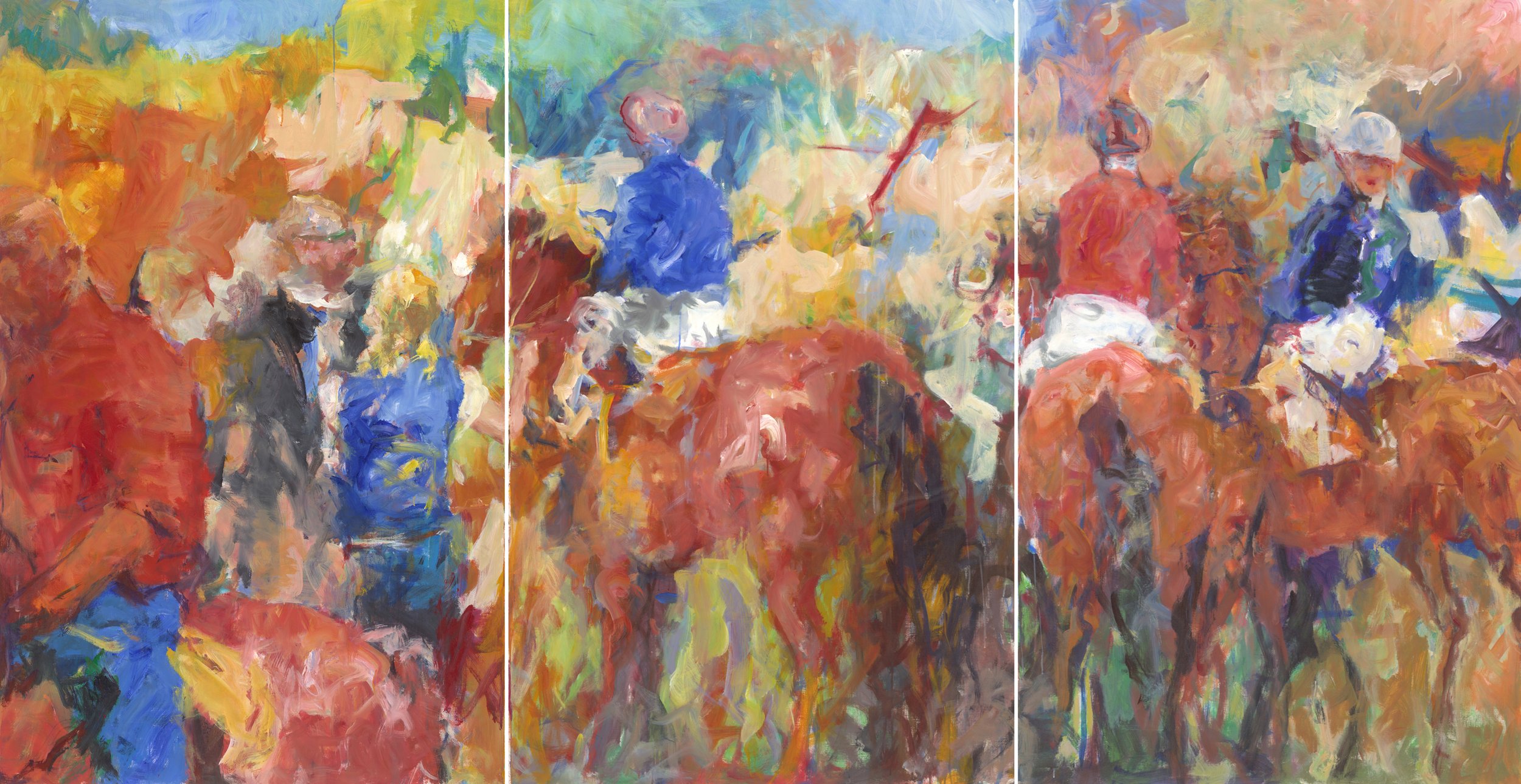
Journey
Oil On Canvas
103×163cm×3
This is a triptych that captures the lively atmosphere of a racetrack through a relatively still moment.
The standing horses and the silhouettes of their riders are the main contents of the image. On the right side of the canvas, three groups of racehorses create a relatively symmetrical arrangement in the midground, while the left edge outlines a rider stepping out of the picture, drawing viewers’ attention to the foreground. The light sky at the top effectively balances the heavy brushstrokes at the bottom, creating an echo between the foreground and background while adding a sense of rhythm to the bustling scene.
In the later part of his career, Edgar Degas painted several similar works as this image, such as Race Horses at Longchamp and Jockeys. His depictions of standing or trotting racehorses, especially from the rear perspective, aim to capture the rare moments of tranquility at the racetrack. In Degas’s paintings, whether depicting pre-race warm-ups or post-race relaxation, there is an undeniable sense of serenity suspended within the canvas.
Interestingly, however, BEI Jiaxiang manages to evoke the vibrant energy of the racetrack within such a similar composition. First and foremost is the role of vivid colors. BEI employs highly saturated, bright hues, exaggerating reality to maximize the hormonal excitement of the athletic event. Next, he brings the overall perspective closer, leaving only a small glimpse of sky while nearly omitting the grass; the clearly defined groups of racehorses fill the canvas, creating an immediate sense of vitality. Lastly, with the overlapping vertical strokes, countless hoofprints are laid at the bottom, while a sea of spectators gathers in the distance, greatly enriching the emotional depth and tension of the painting.
In BEI’s words, the creative process is one of continuous “tossing away,” and in this work, he “tossed away” many of Degas’s shadows, in order to gradually stand upon his own racetrack.