
Silver in the Ash
Silver in the Ash
Oil On Canvas
240×180cm
2024
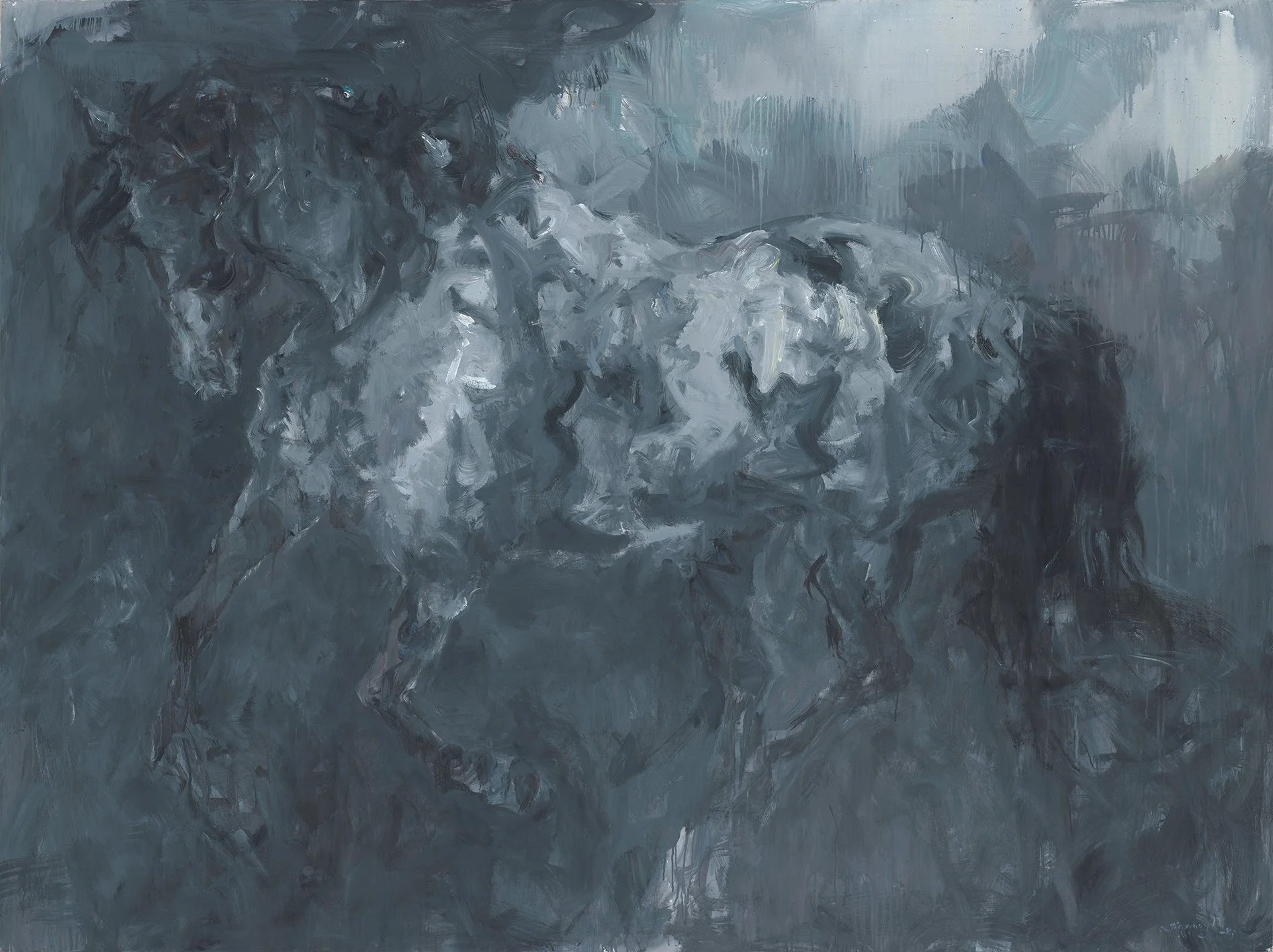
Though grand in scale, this painting strikes the viewer with a quiet yet dynamic presence. The protagonist is unmistakable—a gracefully pacing steed, captured in a left-profile silhouette. Its head is slightly lowered, forehoof lifted with lightness, hind legs stepping naturally in sequence, and tail hanging loosely. The posture exudes not the frenzy of a gallop but the measured cadence of deliberate movement.
BEI Jiaxiang plays a fascinating game of color in this work. At first glance, it appears to be a monochromatic study of a horse in black, white, and gray—but these “blacks” and “whites” hold secrets. This is no mere grayscale rendering. Upon closer inspection, subtle revelations emerge: within the broad swaths of gray on the horse’s body, traces of ochre and the faintest whispers of pale blue are woven in like breath, imperceptibly warming the seemingly austere world and adding rich layers of depth. These “chromatic ghosts” lend the steed warmth and vitality, rescuing it from monotony.
The background, too, is masterfully handled. The deep, shadowy expanse reads as dark gray from afar, but up close, hints of ochre emerge, softening the backdrop with an understated warmth. In the upper right corner, an area verging on white is tinged with the faintest blue, like mist-filtered daylight. This meticulous balancing of tones ensures the composition breathes, free of any oppressive weight. The purest, brightest whites are reserved sparingly—for key highlights on the horse’s musculature, where they act as the final illuminating touches, instantly amplifying the rounded volumes of tensed muscles and the sheen of its coat. These strategic accents elevate the steed from flat depiction to living, dimensional form.
While the horse’s overall form is clearly defined, a closer look reveals that its contours and internal structure are “woven” from undulating, interlaced brushstrokes rather than smooth, solid planes. Even more striking is the sense of fluidity in the oil paint: deliberate drips cascade down the upper canvas, while the lower edges of the horse’s legs blur into the background, their boundaries softened and merging. This is unmistakably intentional—BEI borrows the essence of Chinese ink wash painting, transposing its techniques of diffusion, seepage, and flow into the medium of oil. The result is a composition that breathes with transparency and a rhythmic, almost calligraphic dynamism, as if the horse’s movement stirs the very air around it, and the painting itself pulses with life.
Thus, from afar, this work presents as a stark, powerful monochrome steed, yet up close, it unfolds into a subtle feast of color and motion. With deceptively simple “black and white,” BEI constructs a world teeming with nuance and warmth, infusing oil paint with the luminous, spiritual quality of ink. What it captures is not the fleeting instant of a gallop but the poised elegance of a trot—the near-timeless beauty of movement’s inherent grace.