
Break II — The Genesis of Sensation
French post-structuralist philosopher Gilles Deleuze, in his analysis of Francis Bacon’s paintings, proposed the theory of Affect—the idea that genuine art must expel the “figurative” and “narrative” character of the image, transforming the figure into a “bloc of sensations.” This assertion illuminates with striking clarity the core of BEI Jiaxiang’s new stylistic departure. What he pursues has never been the narration of a figurative story or subject, but rather the direct manifestation of a sensation upon the canvas.
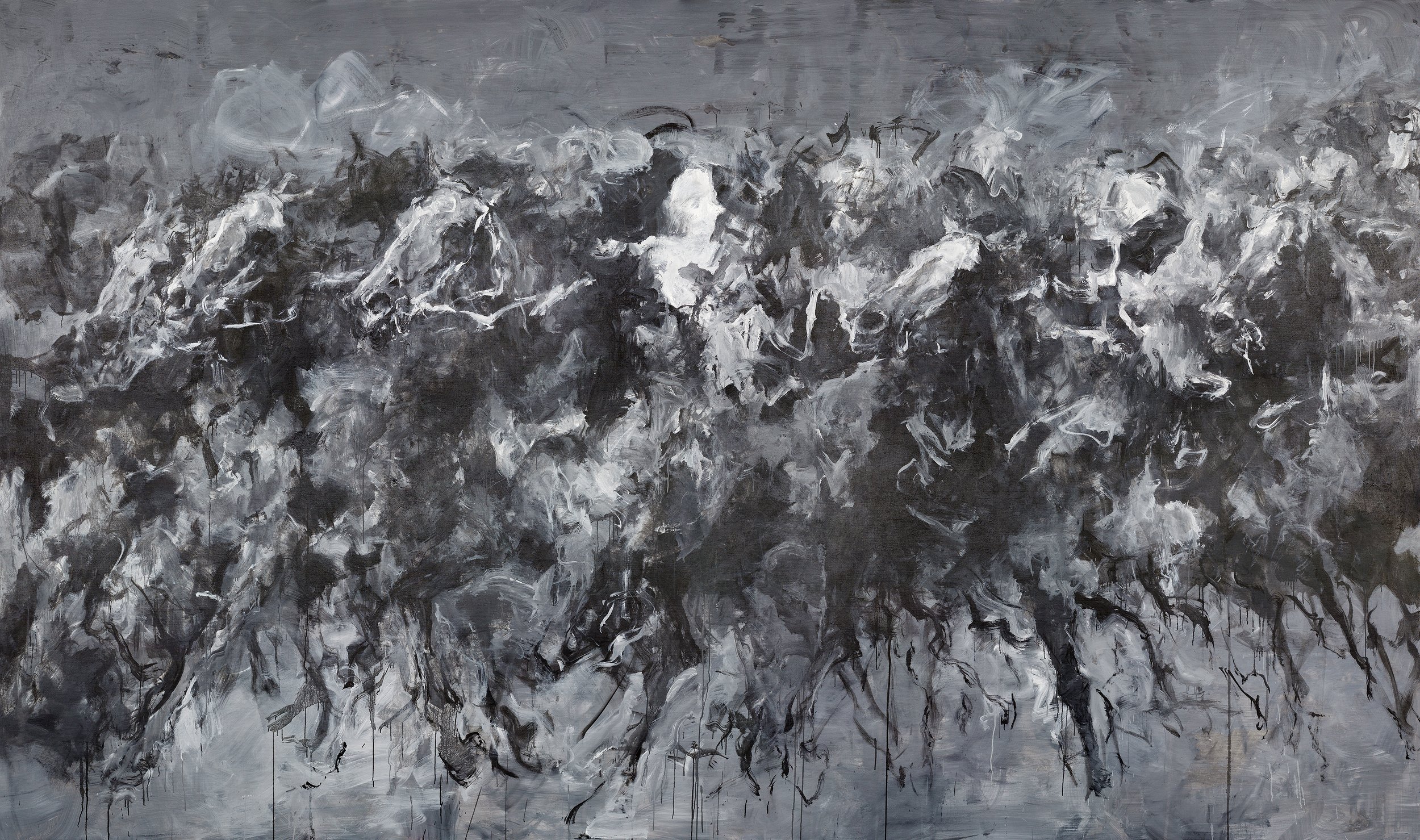
Take the new series of horse paintings as an example. Apart from a few faces rendered with crisp definition, the torsos of the galloping horses largely dissolve into the ambient currents of wind, while the hooves are often indicated by little more than swiftly brushed, coarse lines. Yet the viewer never questions the reality of these steeds, for every deformation BEI employs serves a unified purpose: to present “galloping” itself. It is not a particular, specified horse in motion, but the pure apparition of galloping as a state of life. BEI compresses speed, force, and freedom into the equine figure, making the horse a vehicle of sensation. As he puts it: “No modeling, only vividness.”
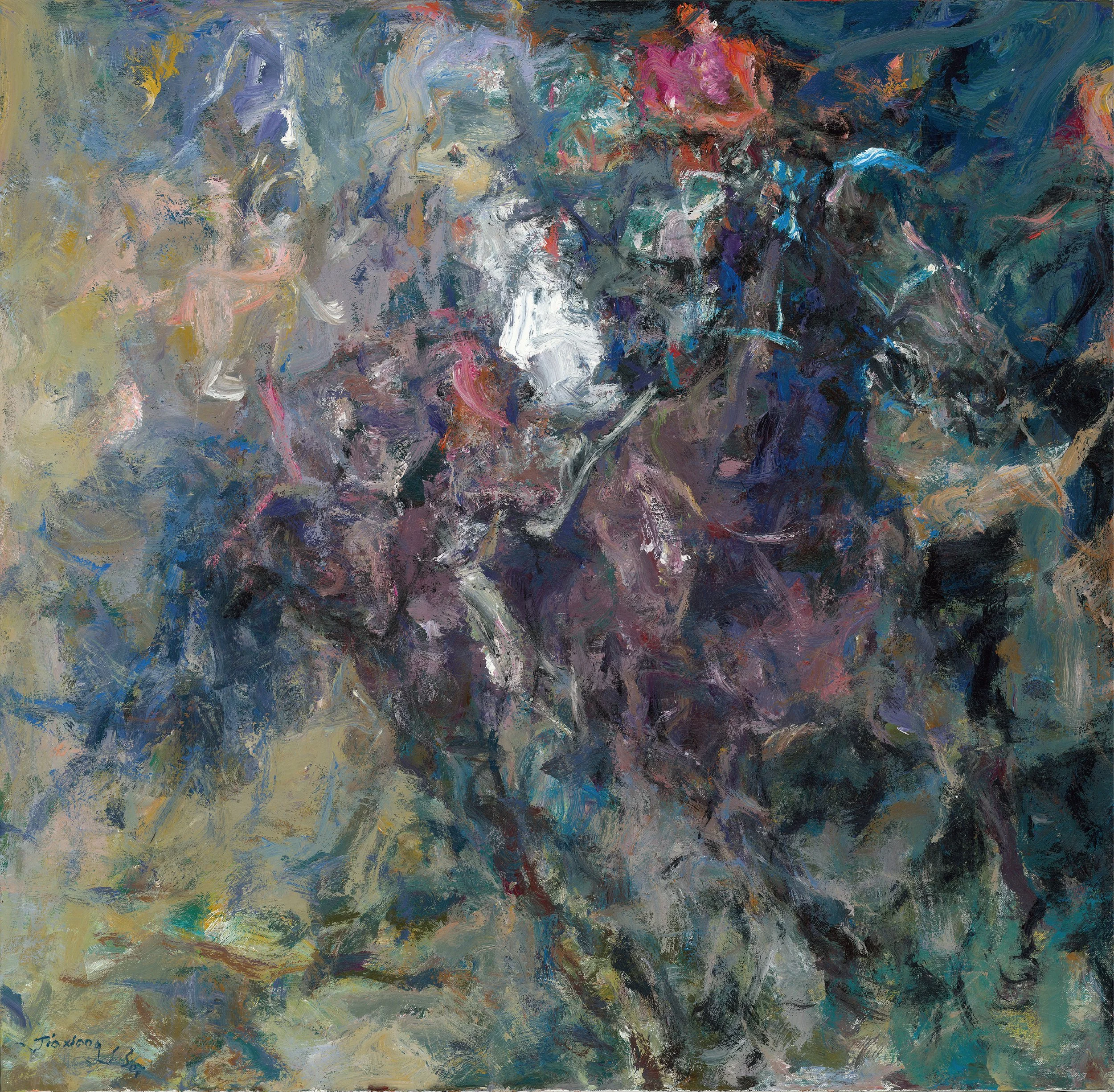
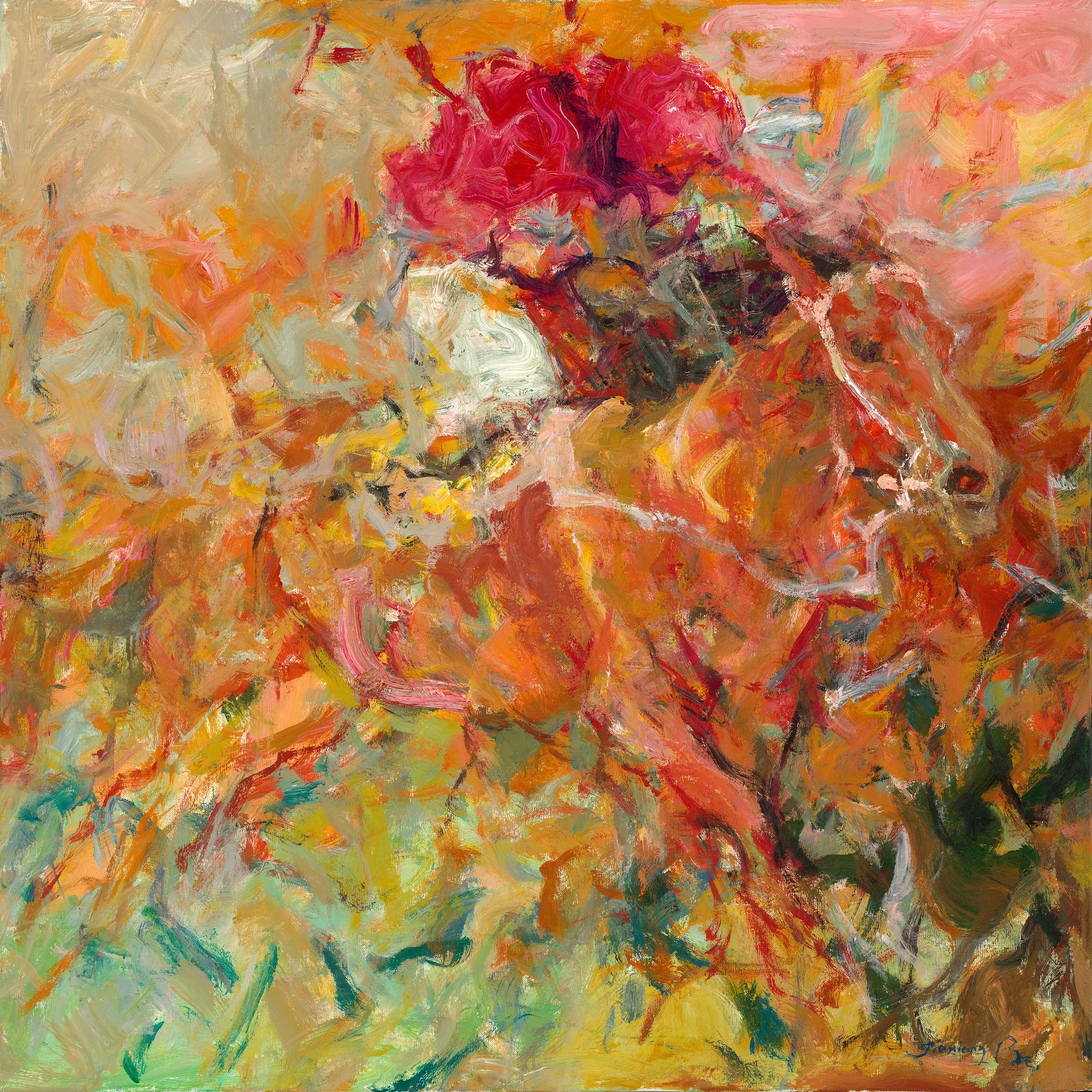
In the brushwork of works such as The Shadow Steed and Riding Wind, the horses’ faces are executed with decisive strokes—a few lines capturing an uplifted spirit. The manes are built from short, dense, layered applications, generating a kinetic, airborne dynamism. The bodies and hind legs are swept in with broad, swift gestures, the direction of the brush aligning with the trajectory of the gallop; the traces of pigment are themselves a visualization of velocity. Seen through the lens of Heinrich Wölfflin, no single part of the painting independently depicts a horse; every part collaboratively engenders the act of running. This is precisely what Deleuze calls the “irreducible synthesis of sensation”—a trembling, coarse line, detached from the whole, would signify nothing, but within the synthesized bloc, it is at once a galloping hoof, and the very contour of speed, power, and wind. The “restraint force” of this new style compared to the last works serves only to render the force of the bloc more purely present.


In the Shanghai Dialect III series, a closer look at the crisp, firm shoulder lines of the qipao women reveals they are not achieved in a single stroke, but through repeated revisions. The edges show accumulations of pigment and dry, dragged traces. These marks record the brush’s hesitations and decisions, allowing the final synthesized line to carry complex strata of emotion. BEI has described this state: “Sometimes when I am painting, it feels like my hand is being guided by something else—it is extraordinarily good. Consciousness, unconsciousness—all are cast aside.” This sensation of the “hand being guided” is the very moment when sensation pierces through consciousness to arrive directly on the canvas.
The new style’s openness to “indeterminacy” likewise echoes Deleuze: art is not an escape from chaos, but an extraction of sensation from chaos, while allowing form to retain the traces of that primal disorder. Deleuze contends that the genesis of sensation does not preexist in the artist’s mind, to be merely painted out; rather, it gradually coalesces into form through the contact of brush and canvas, through repeated application and revision. This is exactly the creative condition BEI Jiaxiang inhabits now. He never predesigns a composition, nor relies on preparatory sketches; instead, he engages in direct dialogue with the pigment on the canvas. Those brushstrokes, seemingly casual yet unfailingly precise, are the externalization of sensation captured in the instant of its emergence.