
Gone in Moonlight
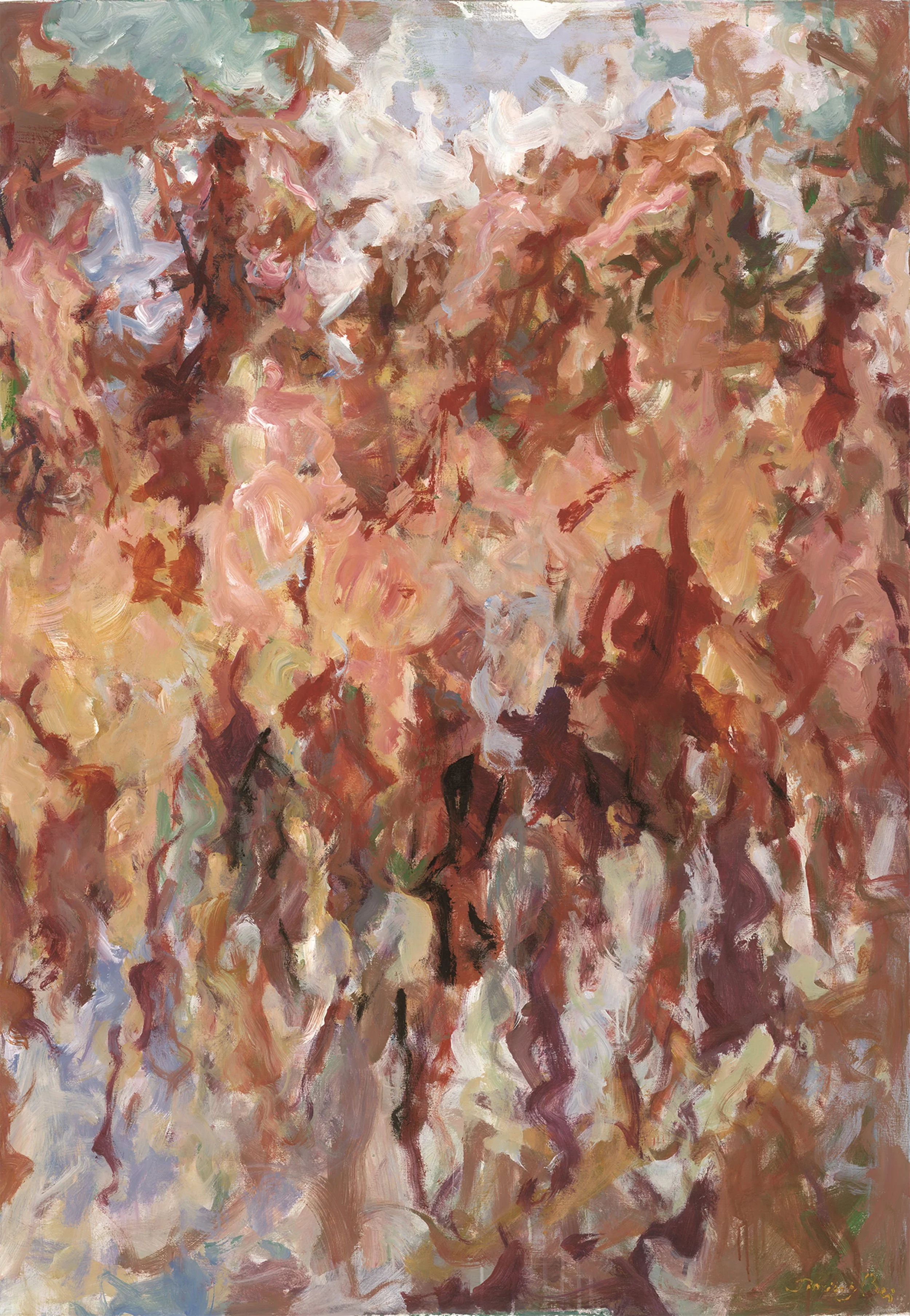
Gone in Moonlight
Oil On Canvas
112×162cm
2024
BEI Jiaxiang’s Gone in Moonlight employs highly abstract artistic language to vividly capture the explosive momentum of galloping horses—moments of instantaneous eruption, almost breaking through the paper. When viewing from a distance, the seemingly chaotic colors and freely flowing lines on the canvas create a wondrous cohesion. Suddenly, a powerful triangular composition emerges—an array of galloping horses charging directly toward the viewer!
The central upper portion of the painting features the lead horse, flanked on each side by two horses extending diagonally upward. These figures, rendered in intense warm colors like yellow, red, and brown, form a rugged and impactful "V" shape. Meanwhile, the areas occupying the top center and the bottom corners of the composition are subtly blended with a pale, almost white tone that seamlessly merges into a misty gray-blue, precisely mimicking the swirling dust stirred up by the pounding hooves. This interplay of virtual and real not only creates a strong sense of spatial depth but also vividly evokes the frenetic scene of a herd of horses rushing forward.
Upon closer examination, BEI’s depiction of the horses themselves is particularly intriguing. The front chest of a horse is rendered with light brown and goose yellow hues, with smooth, even brushstrokes that convey the shiny, sleek coat in sunlight. Turning to the head, the colors deepen, emphasizing those seemingly casual yet ingeniously crafted dark strokes scattered amid the colors. These strokes precisely define the contours of the horse’s neck, while the most exquisite detail lies in the treatment of the eyes. At first glance, the faces of these five horses seem to vanish entirely into a whirl of colors and lines, making it difficult to distinguish them. However, upon focusing, their vivid faces seem to suddenly “leap” out of the chaos! Sharp eyelids, alert ears upright, flaring nostrils—along with an intense, unwavering concentration and forward-driving spirit—are all rendered with remarkable precision. This masterful finishing touch imbues the entire dynamic moment with soul, transforming rushing energy into eternal vitality.
The depiction of the horses’ legs is the most heavily colored area, with deep reds, ochres, and even mysterious purples intertwining and clashing. This is also where the flowing, curved lines are most prominent. Yet, these lines are not precisely defined; their edges are softened with fuzzy strokes, exhibiting variations in intensity and overlapping or entangling with one another. This forms a seemingly unordered web of movement. Such treatment diverges from Van Gogh’s directionally consistent, orderly brushwork, as well as Pollock’s purely spontaneous splatters. BEI’s lines, despite their seemingly wild and unrestrained appearance, actually contain carefully organized internal rhythms and cadences—like an artist conducting a symphony of colors. Through this unique expressive language, BEI masterfully captures the dizzying sense of motion blur during high-speed running, the ghostly afterimages of leaping moments, and the raw primal energy burst forth—depicting not the specific anatomy of legs or hooves, but the very essence of “running” itself, its visual character, and explosive energy.
Therefore, the artistic charm of "Gone in Moonlight" lies in its richly layered viewing experience: awe-inspiring from afar, yet full of hidden mysteries upon closer inspection. BEI Jiaxiang discards realism’s constraints, instead using tense abstract colors and highly dynamic lines to not only shape the vigorous form of the galloping horses but also deeply capture and convey their restless spirit and the fierce, surging wind. The composition nurtures a sense of divine rhythm amid chaos; within the seemingly disorderly flow of lines, a subtle rhythm and order are concealed—together creating a visual magic that invites viewers to repeatedly ponder. It challenges us to actively participate, to use our eyes to “discover,” and to immerse ourselves in the moment—feeling the fleeting yet eternal surge of life’s mighty energy that the painting so powerfully embodies.