
Grand Avenue
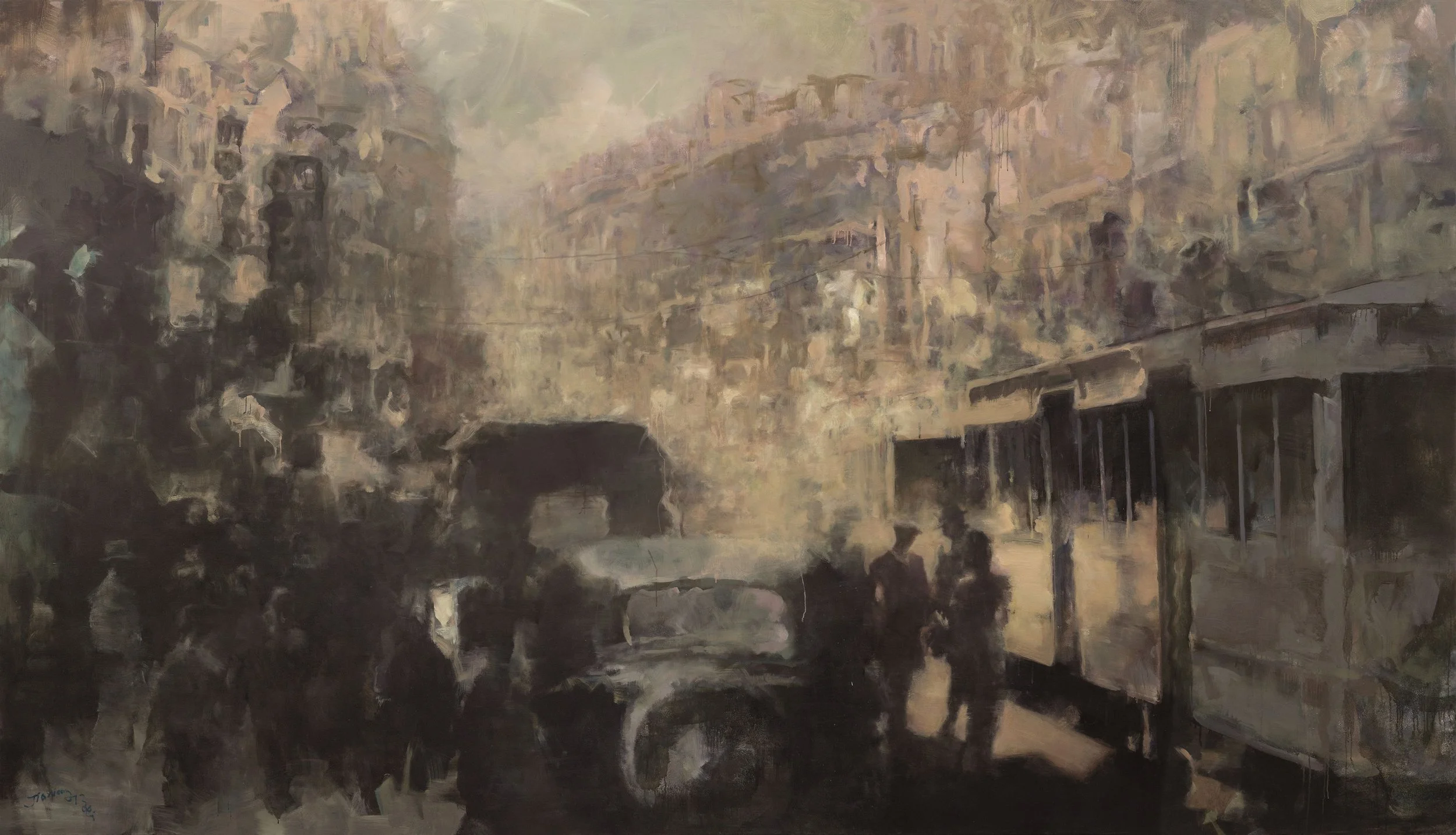
Grand Avenue
Oil On Canvas
410×235cm
2016
This is a Shanghai steeped in moisture. The long, horizontal canvas is like a slowly unfurling reel of period film. The palette is sepia-toned, carrying the gentle brownish hue that old photographs acquire over years. Standing before the painting, one feels as though they are gazing through a thin pane of glass at a world that has long since receded.
The scene captures an ordinary moment on a Republican-era street. On the left is a dense crowd, a mass of deep shadow, with the occasional bright patch of a qipao or the silhouette of a bowler hat emerging from the depths. These figures are indistinct, like silhouettes surfacing from deep within memory. The right side is more spacious—the outline of a tram, the rear of a car, pedestrians crossing the street, all rendered clearer by the slanted light. In the background, old Shanghai-style townhouses converge from left and right, their outlines slightly blurred. As the eye travels deeper into the scene, the colors paradoxically grow brighter, until the farthest point becomes the most luminous area in the entire work. It is a light, shining from the far end of memory—though the past has faded, it still glows.
It depicts a bustling, lively street scene, yet the entire painting is enveloped in a strange stillness, a persistent, indescribable sense of silence. The figures do not seem to inhabit their own time; they appear eternally frozen in an unreachable moment.
It recalls the Italian piazzas painted by Giorgio de Chirico. In de Chirico’s works—with their empty arcades, long shadows, and distant trains—tiny human silhouettes appear lost within vast spaces, cloaking familiar scenes in an aura of mystery. That pervasive sense of alienation arises from a particular way of seeing, as if a pair of eyes is observing all of this from beyond time itself.
De Chirico’s painting was profoundly influenced by Schopenhauer’s philosophy. In The World as Will and Representation, Schopenhauer posits that the world exists both as representation, governed by the principle of sufficient reason, and as Will, a blind, irrational impulse. De Chirico sought to reveal the spiritual forces hidden beneath material appearances, transforming classical perspectival space into a mode of expression used to create a dreamlike world of solitude. The core tenet of Metaphysical painting lies in detaching everyday objects from their usual context, presenting them as images intensified by philosophical fantasy.
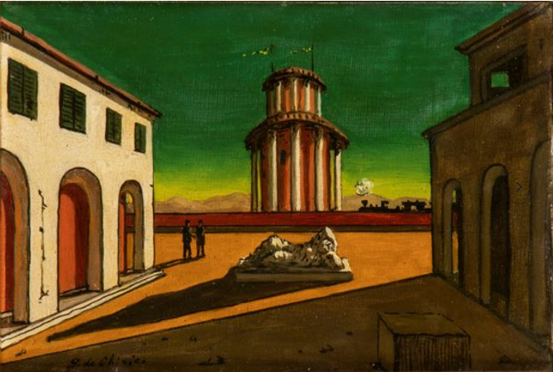
Piazza d'Italia, 1960
GIORGIO DE CHIRICO
Oil on canvas
21 x 31 cm
BEI Jiaxiang’s depiction of a Shanghai street scene similarly embodies such a gaze. It is not the viewpoint of any individual on that street at that time, but rather a contemplation from a later era, a retrospective, a gaze that spans an entire epoch. It is precisely this perspective that abstracts the ordinary street scene from its everyday context, rendering it metaphysical. This phenomenological reduction—stripping things from their natural attitude—reflects what Merleau-Ponty termed the “primacy of perception”: painting is not a copy of the world, but a revelation of “visibility” itself.
De Chirico once said, “Truly profound works always contain a certain enigma.” The enigma in BEI Jiaxiang’s painting lies precisely here: it does not depict a street, but rather how time itself views a street. The Shanghai on this canvas ultimately becomes a place in the philosophical sense—not geographical, but conceptual. It makes visible how time itself perceives a street. And that light growing brighter in the distance is both the exit from the depths of memory and the final destination of this gaze: piercing through the entire street, through all the time that has passed, to settle at this end, where we now stand.