
Riding Wind
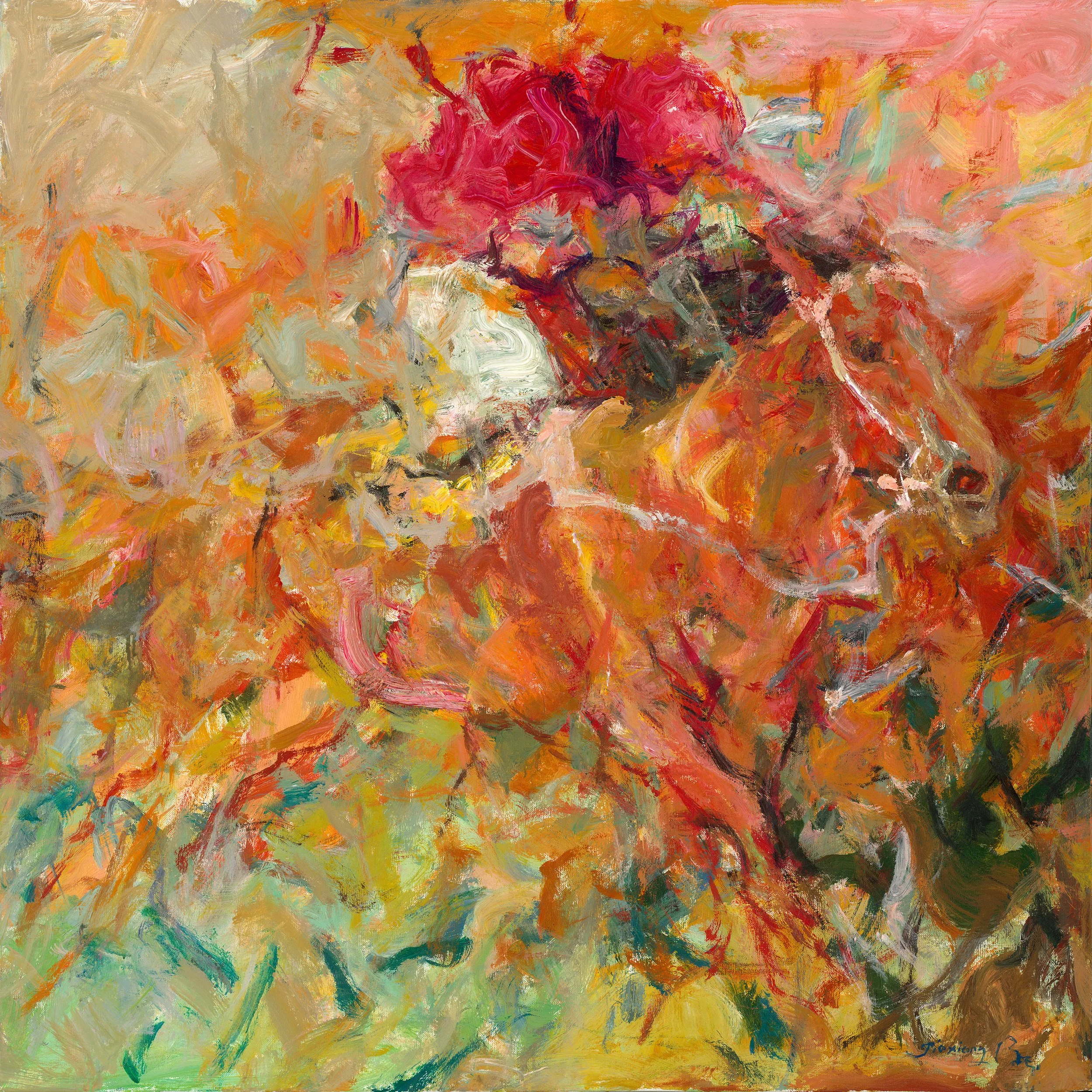
Riding Wind
Oil On Canvas
100×100cm
2025
In a luminous warmth dominated by orange as the focal hue, a jockey and his thoroughbred are about to burst beyond the right edge of the canvas.
Here, BEI Jiaxiang inscribes an invisible dividing line upon the composition—a line that extends from the jockey’s slightly leaning torso down to the horse’s foreleg. This line cleaves the picture into two zones of strikingly different temperaments: on the right, dense, detailed, taut; on the left, limpid, relaxed, almost a form of blankness. The horse’s head on the right, a fiery orange-red, is rendered with full, muscular precision. Two strokes of pale yellow on the neck are especially masterful: with just a few touches, they powerfully evoke the swell of muscle beneath. The tumultuous, saturated background seems to hint at other riders racing alongside. On the left, the horse’s belly and hind legs emerge only as faint orange contours, their muscular masses nearly merging with the background—as if the sheer speed of the gallop has blurred the body’s edges into afterimages. Beneath the horse, interwoven strokes of pale green and warm color capture the fleeting shadows of the turf; this cool intervention momentarily breathes into the heated palette, easing the tense density of the right side.
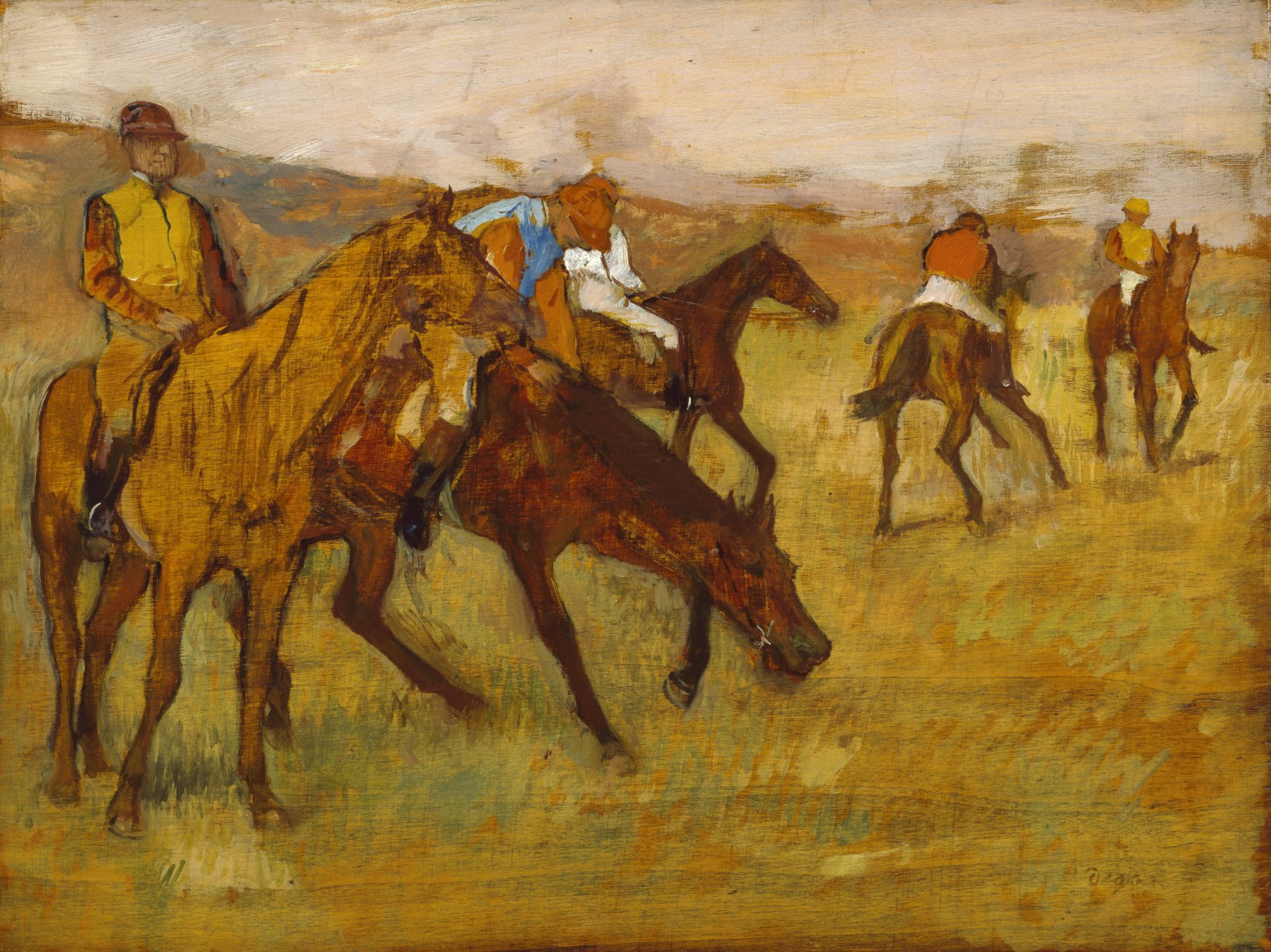
Before the Race
In Degas’s late racecourse paintings, one often finds asymmetrical compositions with sharp foregrounds and blurred backgrounds, where the painter uses variations in brushwork density to differentiate primary from secondary and to generate a sense of speed. In this work, BEI Jiaxiang compresses that very contrast onto the body of a single horse—the front in focused sprint, the rear dissolving into peripheral blur. The sense of directional charge thus acquires an internal momentum. That unseen diagonal line is not merely the invisible spine of the composition; it becomes the visual embodiment of speed itself. It forces the eye to distribute its weight across the canvas: lingering on the right, glancing past the left. The horse’s motion thus becomes the very rhythm of looking.