
Miracle Steed
Miracle Steed
Oil On Canvas
100×100cm
2025
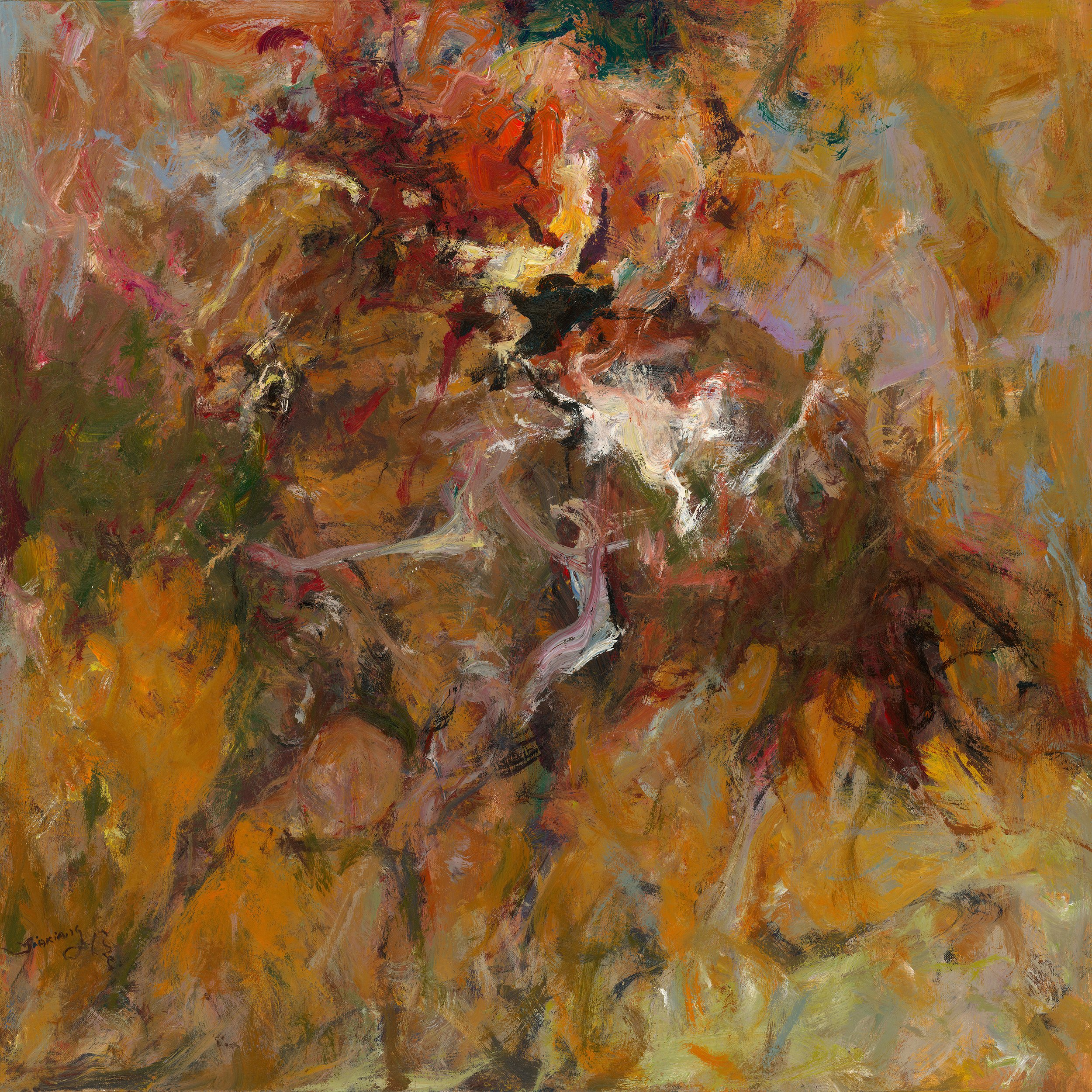
The overall tonality is a classical warmth, with subject and background situated in almost the same chromatic range—the difference minimal. Yet through his extremely restrained command of color, BEI Jiaxiang makes a racehorse gallop from right to left across the canvas.
Olive green hints at the coolness of leg muscle and the reflection of the ground; mauve-pink marks the belly’s turn against the warm background; a pale-yellow highlight precisely lifts the cheekbone’s volumetric form. These seemingly casual patches of color shoulder the entire burden of representation. BEI, working almost by subtraction, constructs the horse’s volume and dynamism within a remarkably narrow interval of chromatic difference.
This practice—letting color generate form directly, allowing parts of the body to recede into the background—resonates inwardly with Willem de Kooning’s aesthetic of “formlessness.” De Kooning sought to return art to freedom, to resist the constraints of predetermined form. In his theory, color and line no longer serve a pre-established contour; they become direct traces of emotion and energy. Painting thus becomes an “informed” presence. BEI does the same: those few strokes of olive green, mauve-pink, pale yellow do not reproduce the horse’s inherent colors—rather, color speaks for itself. They do not cling to a drawing’s framework; instead, they directly constitute visual equivalents of muscle, bone, and light. The disappearance of the horse’s hind leg pushes the “formless” to its extreme—where form vanishes, speed and breath appear.
With chromatic nuances, on the boundary between harmony and dissolution, BEI Jiaxiang makes paint become form itself, allowing the body to achieve infinite possibilities between the visible and the invisible.