
Neighing in Wind
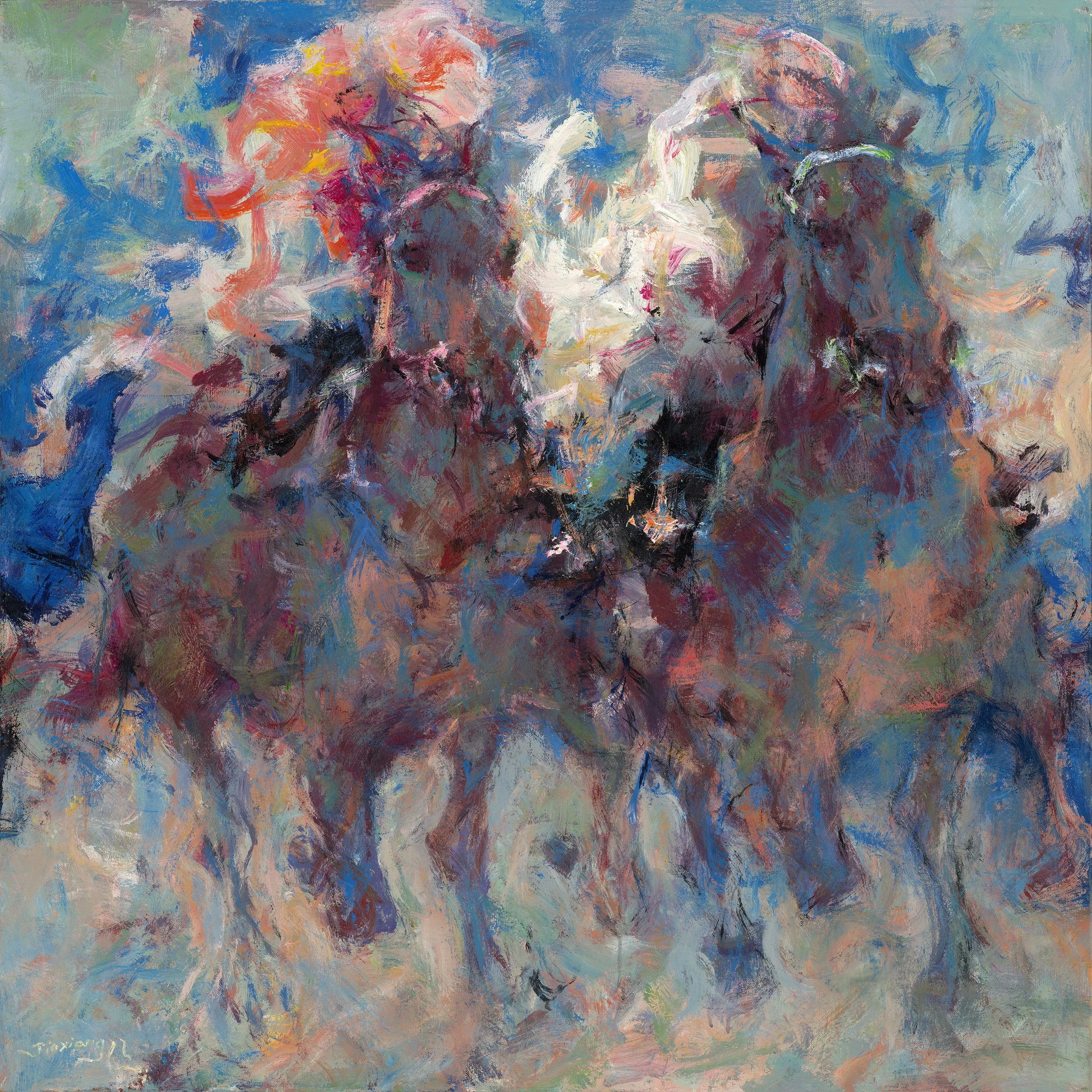
Neighing in Wind
Oil On Canvas
100×100cm
2025
This piece leaves no room for the viewer’s gaze to prepare or linger—two racing horses, rearing and surging forward, fill the entire canvas with an almost explosive force.
Their rounded, powerfully muscled chests press almost horizontally against the edges of the frame, compelling visual focus entirely onto the explosive forward drive of their charge. Hooves are suspended in mid-air, maintaining a subtle, almost-there distance from the bottom edge of the canvas, perfectly freezing that moment of takeoff. The jockeys on their backs, meanwhile, dissolve amidst BEI Jiaxiang’s seemingly rapid brushwork, their concrete forms reduced to streaks of color intertwined with the flying manes.
In terms of color, BEI employs cobalt blue as the composition’s dominant melody, constructing an atmosphere of the racetrack that is both cool and intense. The upper part is cooler, the lower part slightly warmer; within these subtle shifts in color temperature, he distinguishes the sky from the churned-up earth. A small patch of deeper cobalt behind the horse on the left serves as the painting’s chromatic anchor. It resembles a fissure in the void, not only forcibly creating a sense of depth across the flat canvas but also visually balancing the intense reddish-brown of the foreground horses, endowing the dynamic composition with a grounded sense of weight.
In his handling of tone and texture, BEI Jiaxiang draws inspiration from the tension-charged dynamism found in the work of French Romantic painter Théodore Géricault. Overlaid onto the reddish-brown base of the horses are strokes of blue and yellow harmonized with the background colors. These seemingly irregular applications resemble dust or light, yet casually and precisely contour the lines of the muscles and the shapes of the faces. This approach is more a form of “writing”—the fusion of color and form emerges naturally through the expressive application of paint, embodying the Chinese painting principle of “intent precedes brush.”