
Wind Blast
Wind Blast
Oil On Canvas
153×158cm
2017
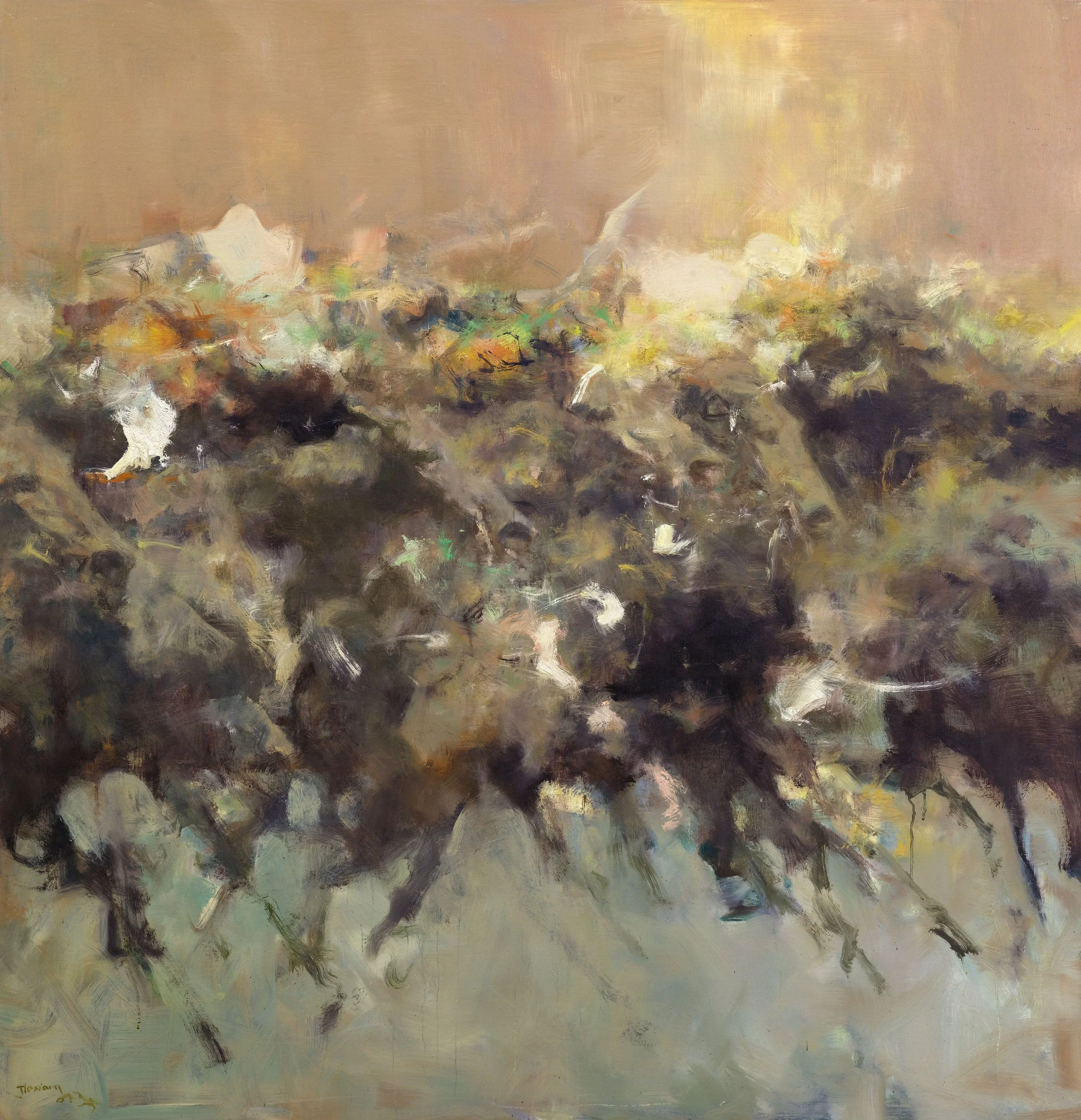
This painting presents a tension-filled equilibrium. On a scale of approximately 1.58 square meters, BEI Jiaxiang constructs a visual dialectic: tranquil colour fields confront surging momentum, warm undertones merge with cool, ethereal dust. The herd of horses precisely bisects the composition. The upper half consists of a smooth, soft light ochre, flat and even like still air, with only a touch of goose-yellow subtly gradating like sunlight within it. The lower half, working within a similar brown palette, is overlaid with a gray infused with hints of blue and green, the uncovered base color seeping through at the edges, suggesting that the upper layer is the dust cloud just raised by the thundering herd, yet to settle.
This floating quality of the cool gray layer is exquisitely handled. It is not a realistic depiction of the earth, but a visual recording of movement. It hovers above the base color like a luminous mist stirred by hooves in a slow-shutter photograph—simultaneously figurative and abstract. This technique recalls Turner’s diffusing water vapor and luminous mist. Yet, unlike Turner’s Romantic pursuit of dissolving all things into light and atmosphere, BEI’s dust cloud possesses a greater sense of physical substance. It is a trace of force, the vestige of momentum. If Turner’s mist is ambiance, then BEI’s smoke is energy.
The central tension of the canvas, however, lies in the brushwork itself, which is undergoing a metamorphosis. This group of galloping horses stands at the crossroads of BEI’s artistic language: it retains the softness of Impressionism, attempting to capture instantaneous light, color, and movement, while simultaneously beginning to sprout the sharpness and unfettered freedom characteristic of his later, highly modern style. The forms of the herd are no longer concrete; the boundaries between riders and horses blur and merge in the rapid motion, making it difficult even to count how many living beings are surging within this whirlwind. This very indistinguishability is the source of the painting’s majestic momentum—it no longer depicts specific horses, but depicts the essence of galloping itself.
This transition—between figuration and abstraction, between soft brushstrokes and sharp lines—constitutes the unique aesthetic texture of the work. The deformed figures in the paintings of De Kooning, a representative of American Abstract Expressionism, similarly inhabit the threshold between the figurative and the abstract. De Kooning dismembers form with frenzied brushstrokes, and in that dismemberment, reconstructs an even more violent vitality. Bei’s exploration here strikes a similar chord, yet its temperament is more Eastern. De Kooning’s lines are about tearing and conflict; whereas BEI, even with his sharp lines, remains enveloped in the harmonious atmosphere created by the warm ochre and cool gray. His deconstruction is not for the sake of subversion, but to release the inner vitality of the image—a composed transformation of the Eastern freehand spirit within the language of oil painting: an expression of imagery born naturally from the flow of painting, not deliberately imposed.
Ultimately, this painting presents a remarkable realm: within extreme dynamism, we perceive structural stability; within sharp brushstrokes on the verge of taking shape, we see the accumulation of a soft, traditional past. The balanced composition and comforting hues act like a contemplative fence, corralling the unstoppable herd within the bounds of aesthetics. We hear no neighing, yet feel the overwhelming force rushing toward us. This is the perfect footnote to BEI Jiaxiang’s principle of Eastern Rhythm in Western Language: using the texture of Western oils, he captures the transcendent charm of being alike yet unlike cherished in Chinese literati painting, and also portrays the most moving and precious transformation of an explorer navigating the space between two stylistic worlds.